El laberinto
Los renglones torcidos de DiosEl laberinto is both a name for Alice Gould’s predicament and a spatial image through which the novel makes that predicament tangible. At a doctors’ meeting, she acknowledges that she has entered a maze and cannot get out without help. The metaphor gathers together her confused exchanges with the hospital’s director, the secrecy surrounding her client, and the physical passages of a hospital housed in an old charterhouse. Its force lies in the difference between being able to move through a place and being able to find a way out of the situation that place has created.
A predicament Alice cannot solve alone
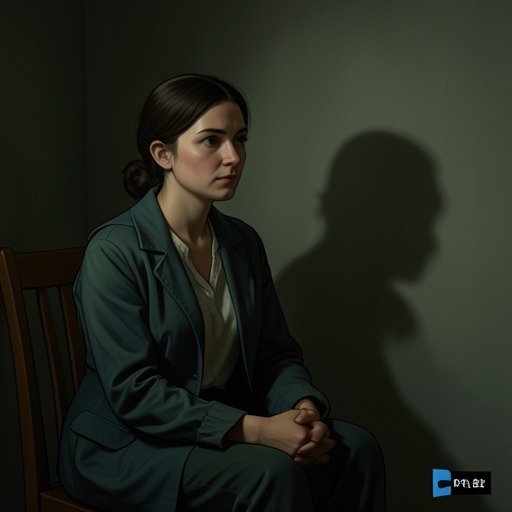
When César Arellano invites Alice to cooperate with the doctors so they can help her, she agrees that she needs their assistance. Her image of the labyrinth is therefore not simply a complaint about confinement: it is an admission that her own account has reached an impasse. She has entered a situation whose terms she cannot make intelligible to the people questioning her, and she does not believe she can resolve it without their help.
That admission sits beside her reluctance to explain what brought her there. Asked to tell her story as if the doctors knew none of its background, Alice pauses because speaking could compromise her client’s honor and safety. She invokes professional secrecy and insists that she has never betrayed it. The maze thus has an ethical dimension as well as a personal one: the account that might help Alice explain herself could also expose someone she is bound to protect. Help is necessary, but accepting it requires negotiating what she can disclose.
Corridors that make confusion visible
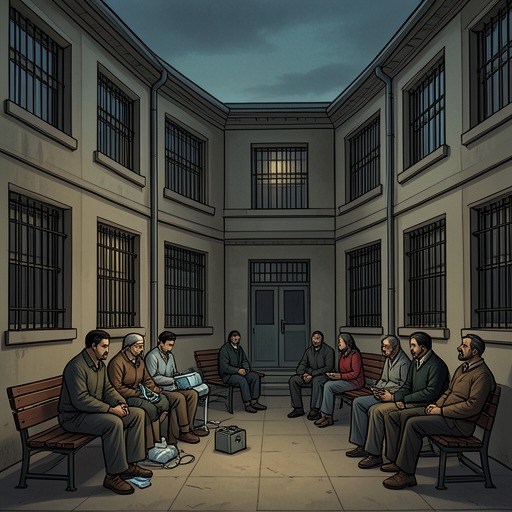
The meeting takes place against a setting whose architecture gives the metaphor a concrete counterpart. The hospital’s boardroom occupies the former chapter house of the old charterhouse. To reach it, Alice walks along an extraordinarily low stone passage. She has to retrace part of her route because the corridor is too narrow for two-way traffic when people approach from the opposite direction. The route does not merely connect rooms; it forces her to turn back and wait for others to pass.
At a widening in the passage, where a loophole once allowed the Carthusians to shoot arrows if attacked, Alice stops to let the people coming out proceed. There she recognizes the author of Teoría de los Nueve Universos, hanging limp from the nurses’ arms like a rag doll. The meeting of old defensive architecture and present-day institutional care is part of the scene’s significance: the corridor bears a history of guarded space, while its current traffic makes Alice confront another patient being physically escorted through it. The narrative does not make the building a literal puzzle with a solution; instead, its narrow turns and forced pauses give bodily form to disorientation and dependence.
The open regime and its limits
The maze is not simply a network of locked doors. Montserrat Castell explains that the hospital has had an open regime for only a few years, allowing patients relative freedom to move around the building and grounds. Residents may gather at the bar, play dominoes, brisca, or parcheesi, walk and talk in the garden, go into the extensive wooded area, attend occupational therapy, or work in workshops that produce goods for sale. Those who work receive varying wages according to their abilities and performance. Patients may even leave the hospital by bus for nearby towns, an option especially popular during local festivities.
That range of movement complicates the image of entrapment without cancelling it. The freedom is relative, and Montserrat adds that there are many exceptions to the general rule. The hospital can offer social life, work, and excursions while remaining the setting in which Alice cannot make her own status understood. A patient may have room to walk through the grounds and still have little power over the meaning assigned to an admission or over the procedures governing it. El laberinto describes this mismatch: visible movement does not guarantee control over one’s circumstances.
A maze of accounts and procedures
Alice’s bewilderment becomes sharper when the director distinguishes voluntary admission from what her file records. He explains that a voluntary stay would have required a declaration signed by Alice and a certificate from Teodoro Ruipérez, the doctor who received her. Her file instead contains the procedures used for involuntary cases: a medical certificate from E. Donadío, registered in Madrid, stating that she was ill and needed hospitalization, together with an application from her husband, Heliodoro Almenara, as her relative. The distinction turns on documents and on who has authority to initiate confinement, not merely on Alice’s own description of why she is there.
This exchange supplies the maze with institutional walls. Alice says she is present of her own will and identifies herself as a professional detective, while the director points to a file that classifies her admission differently. The available evidence does not make every detail of her predicament equivalent to a corridor or a locked cell; rather, it shows how competing accounts and formal procedures can make her position difficult to navigate. The metaphor’s decisive meaning is therefore relational: Alice needs other people’s help, but she must seek it inside an institution whose records and judgments do not initially match her own explanation.